Garage Door Bottom Seal & Doorstop Molding Replacement, Hampton Roads
If daylight is showing under your garage door, your power bill is climbing in July, or you have found mouse droppings against the inside of the bottom panel, you have a seal problem. Cheap big-box seals last 2 to 3 years in coastal humidity. We install coastal-rated EPDM bulb seals and cellular PVC doorstop molding that survive salt air, hurricanes, and the Norfolk roof rat. Written, line-item quote before we cut anything. Same-day on weekday calls placed before noon.
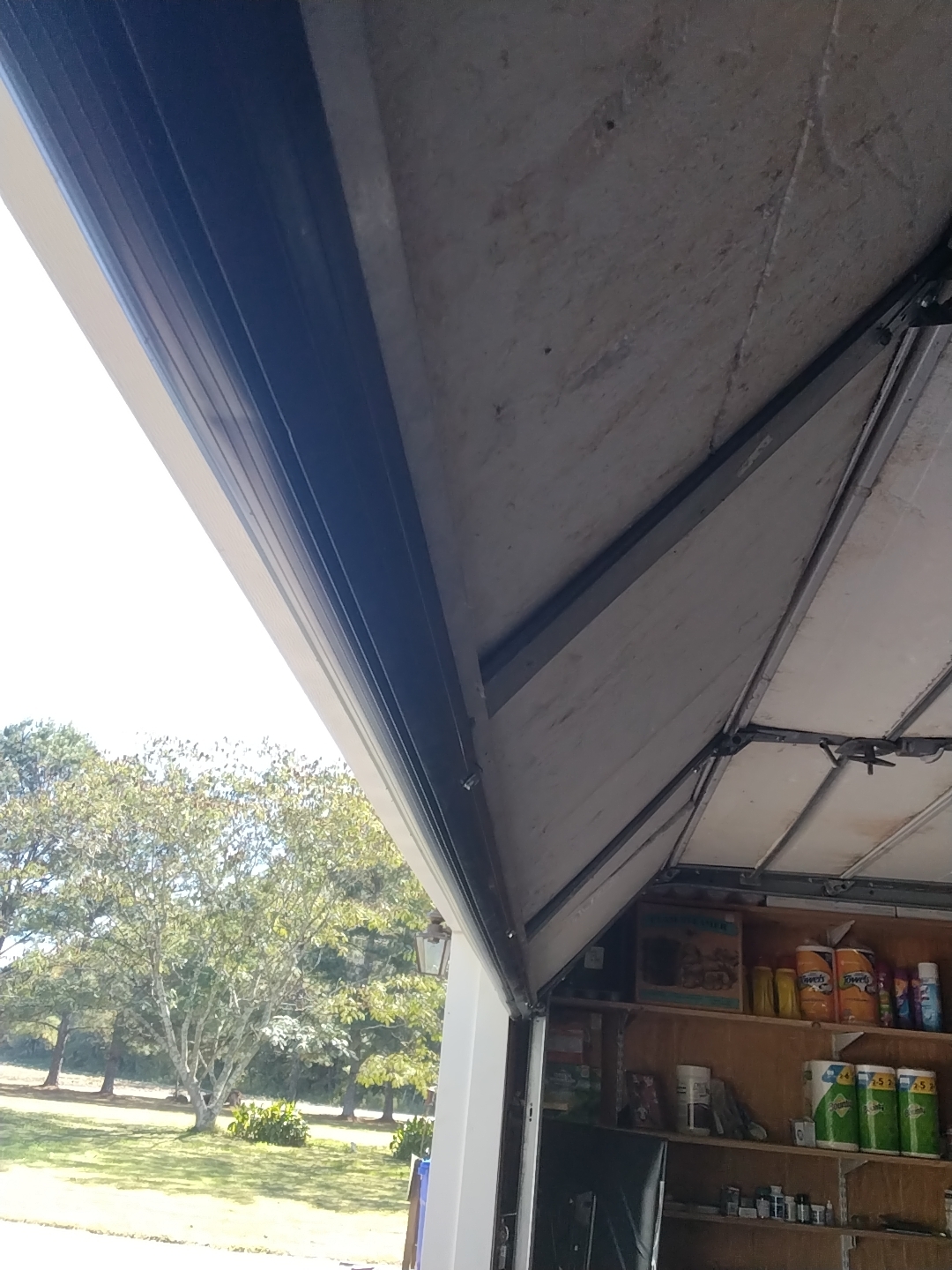
Real installed EPDM bulb seal. Photo from a recent Hampton Roads job.
Why the strip at the bottom of your garage door matters more in Hampton Roads
A healthy seal is barely 1/2 inch of rubber. A failed one costs you money in two specific ways every month, and in this region those costs add up faster than anywhere inland.
🐁 1. Rodents and bugs walk under a failed seal
A house mouse fits through a 1/4-inch gap. A young Norway rat needs 1/2 inch. The City of Norfolk officially lists three rodents as public health pests: the Norway rat, the house mouse, and the roof rat. Roof rats are notably more common in coastal Hampton Roads and Tidewater than anywhere else in Virginia. In rural Suffolk, Smithfield, and Isle of Wight you also get the native deer mouse and white-footed mouse.
Bugs that walk under a failed seal in this region: the American cockroach (the "palmetto bug" locals talk about), German cockroach, the camel cricket that thrives above 70 percent humidity, Eastern subterranean termites that scout from soil under the slab, the black widow spider, mud daubers and paper wasps, and Argentine and carpenter ant colonies.
Snakes follow the rodents in. The Eastern black rat snake and the Eastern garter snake are the two most common in a Hampton Roads garage. Less common but documented in coastal VA: the Eastern copperhead (venomous, drawn in chasing rodents during heat waves), the DeKay's brown snake, and the rough green snake. All of them follow a rodent trail through a failed bottom seal. Black rat snakes will hunt the rodents themselves and are usually beneficial; the trouble is the next homeowner who walks into the garage and cannot tell a rat snake from a copperhead.
The damage costs more than the seal job. Rodents chew the insulation off low-voltage opener wiring, GFCI feeds, and the thermostat data line in most newer Hampton Roads homes, all documented fire risks that insurance carriers list separately from weather and theft. Beyond structural damage, Norway rats and roof rats in Tidewater have tested positive in regional public-health surveys for leptospirosis and serve as ride-along hosts for the ticks moving north from coastal wetlands. Sealing the perimeter is the cheapest first move, because bait stations and exterior pest service both assume the rodent has already established a route in.
Our fix: EPDM bulb seal with optional stainless-mesh inner core upgrade. Rats cannot chew through stainless mesh. PVC doorstop molding closes the vertical gaps on the jambs where mice and the rat snake that follows them climb in.
⚡ 2. The garage is your home's biggest air leak
Department of Energy modeling puts the garage-to-home interface at 10 to 13 percent of total home air leakage. A half-inch gap across a 16-ft garage door is 96 square inches of constant outdoor air exchange. In Hampton Roads, the August dew point averages 71F and December nights dip into the 30s, so your HVAC is fighting that hole 11 months of the year. Dominion Energy residential rates run 16.43¢/kWh as of June 2026, with an approved increase for late 2026 (the first base-rate hike since 1992). The room over the garage feels it first.
What that hole actually costs in Hampton Roads dollars: attached-garage homes in coastal Virginia typically see an extra $180 - $340 per year on their power bill from a single failed perimeter, with the bonus room over the garage running 4 to 8 degrees off the thermostat year-round. A new EPDM seal and PVC molding job usually pays for itself inside the first 18 to 24 months.
And it is not just air. A failed seal lets in coastal pollen (oak in spring, ragweed in late summer), salt-spray that pits the inside of your door panel and opener housing, fine dune sand that grinds HVAC blower bearings, and the 70 percent humidity that condenses on every cold surface inside the garage. Hidden costs: quarterly filter changes instead of seasonal, condenser coil corrosion, mold along the bottom of the panel, and the musty smell when you open the door from the kitchen.
Insulating the door alone does not solve this. An R-18 door with a failed seal still leaks at the perimeter; insulation slows conductive heat transfer, not air infiltration. Older Hampton Roads homes (built before the 2018 IECC code update) leak measurably more at this seam than new construction, which is why a fresh perimeter on a 1990s home often beats a brand-new garage door on duty-cycle savings.
Our fix: matched cross-section seal, properly seated in a clean retainer, plus rot-proof doorstop molding on the sides and header so the perimeter is closed, not just the bottom edge. On attached garages with a bonus room above, we recheck HVAC duty cycle a week after install. Most customers report the room back on temp within the first day.
One thing we check on every seal visit: the springs. A door with a failing seal has usually been slamming that bottom edge for years, and fatigued torsion springs are what slam it. If your door has also been closing harder or faster than it used to, have us look at both in one visit through our same-day spring repair in Hampton Roads, it saves you a second service fee.
Six signs your bottom seal or doorstop molding is gone
1. Daylight under the closed door
Stand inside, kill the lights, look at the bottom corners. Any daylight means a finished seal. The center sags last, the corners go first.
2. Sand or leaves keep blowing in
Sandbridge and oceanfront customers, this is the early warning. If you sweep the garage twice a week and the sand keeps coming, the seal has flattened.
3. Mouse droppings against the door
Small dark rice-grain pellets along the inside of the bottom panel mean a rodent has already mapped the gap. Replace the seal and bait the corners.
4. Rotted strip on the jamb
If the wood strip on either side of the door has soft spots, peeling paint, or pulls away when you press it, the pine stop molding is done. PVC stops do not rot.
5. Cracked or chalky rubber
Pinch the seal. If it splits, stays flat, or leaves a chalky residue on your fingers, UV and salt air have baked the plasticizer out. End of life.
6. Power bill rising in July or January
A failed seal is a constant outdoor air exchange. The room over the garage gets hot or cold first. Compare your kWh year-over-year for the same month.
Hampton Roads bottom seal & doorstop pricing
2026 price ranges across the Hampton Roads market for bottom seal and doorstop molding work. Every customer gets a written, line-item quote for their specific door before any cutting. Parts in stock on the truck for Clopay, Amarr, and C.H.I. retainers.
Bottom seal only
Coastal-rated EPDM bulb seal slid into a cleaned, reseated retainer. The 60-minute job.
Combined seal + doorstop
EPDM bulb seal plus cellular PVC molding on both jambs and the header. The full perimeter rebuild.
Doorstop molding only
For when the seal is fine but the pine jamb molding has rotted. Cellular PVC, stainless fasteners, fresh vinyl flap.
Optional add-ons
Ranges reflect the local Hampton Roads market in 2026 and depend on door size, seal profile, retainer condition, jamb substrate (wood, stucco, brick), and coastal vs inland address. Same-day on weekday calls placed before noon. Free on-site estimate. 5-year workmanship warranty.
The four bottom seal profiles and which one fits your door
Big-box stores sell “universal” seals. They fit roughly nothing perfectly, and a mismatched profile slides out the first time the door cycles. Here is what we actually carry on the truck.
T-style (most common)
A single T-shaped spine slides into a one-channel aluminum retainer. Standard on most modern Clopay, Amarr, and C.H.I. steel doors built after 2000. Good for flat floors. We carry it in EPDM bulb and natural rubber.
P-bulb (forgiving on uneven floors)
A T spine with a round bulb that compresses well on uneven concrete. The right choice if your slab has a 1/4 to 3/8 inch dip from one side to the other. Most coastal homes with settled slabs benefit from this.
J-style / double-T (older wood doors)
Two T-shaped lips slide into a double-channel retainer. Common on Wayne Dalton wood doors and older Clopay residential. If your retainer has two parallel slots, this is what you need.
Bead-end / dual-bead (specialty)
Two beaded ridges that slip into a slotted retainer. Found on a small subset of Raynor and older C.H.I. doors. We stock it; if you bought the wrong shape at Home Depot, this is why it would not stay in.
Not sure which one you have? Text us a phone photo of the bottom corner of your door and we will identify it in under a minute, before we dispatch.
Doorstop molding: the rotted strip on your jamb that lets bugs walk in
The bottom seal closes the gap under the door. The doorstop molding closes the gap on the sides and top. Different product, separate failure mode, almost no one in Hampton Roads explains it.
What is the doorstop molding?
The narrow wood or PVC strip with a flexible rubber or vinyl flap stapled to the inside edge, running up both jambs and across the header. Sometimes called jamb stop, weatherstop, or perimeter seal. It is screwed or nailed to the door frame, not the door panel itself, and it touches the door from the side when the door is closed.
Why it rots fast in Hampton Roads
Most homes built before 2005 use finger-jointed pine stop molding. Hampton Roads averages 70 percent relative humidity year-round and 47 inches of rain annually. Brown-rot fungi establish in pine within 5 to 7 years here, faster if the molding contacts the concrete slab and wicks moisture. The paint peels first, then the bottom 6 to 12 inches go soft, then the flap pulls away.
What we replace it with
Cellular PVC stock, the same material used on coastal porch trim. It does not rot, does not absorb water, does not need paint to survive. Pre-drilled at 6-inch intervals, fastened with stainless trim screws, capped with a fresh flexible vinyl flap. Lifetime install. We have not had a PVC stop molding fail in coastal Hampton Roads, ever.

Quick check: stand outside, push gently on the bottom 12 inches of the jamb stop. If it deflects or the paint cracks, it is rotted. If you can see the flap pulling away from the wood with a gap behind it, bugs and humid air are already moving freely through that gap.
Situations we solve every week in Hampton Roads
A flat floor, intact retainer, and a single-car door is a 60-minute job. Then there are the unique cases. Below is what we actually see, organized the way you would diagnose it.
Cracked or UV-baked rubber bottom seal
Coastal-rated EPDM bulb seal slid into the existing retainer. The most common and cheapest fix in the lineup.
Rotted pine doorstop molding
Rip out, replace with cellular PVC, pre-drilled at 6-inch intervals, stainless trim screws, fresh vinyl flap.
DIY seal that fell out the next day
Wrong cross-section. We identify your retainer profile and slide in a matching T, P-bulb, J, double-T, or bead-end seal.
Unleveled garage floor, 1/4 to 3/8 inch dip
P-bulb seal compresses more on high spots, no threshold strip needed.
Severely uneven slab, 3/8 to 3/4 inch dip
P-bulb plus weep-slot threshold strip so trapped moisture drains instead of rusting the panel.
Salt-pitted aluminum retainer
Sandbridge, Ocean View, Willoughby, oceanfront Croatan. Retainer corroded through, full swap plus EPDM seal.
Stucco, hardiboard, or brick jambs
Different fastener spec for each. Epoxy anchors for stucco, carbide trim screws for hardiboard, Tapcon masonry anchors for brick. Same-day job.
Heavy rodent breach
Chewed seal, droppings inside the panel. Stainless-mesh inner-core upgrade that rats cannot chew through.
Snake spotted in the garage
Seal the door, sweep the exterior perimeter for the rodent trail it followed. Full rodent and snake explainer.
Termite damage in pine stop molding
Replace with cellular PVC (termites cannot eat it), referral to a vetted local pest company for the colony.
Wind-load rated door
Poquoson, Buckroe, Outer Banks corridor. DASMA 108 / Miami-Dade impact-rated seal kit per our hurricane prep guide.
Modern aluminum-and-glass door
Clopay Avante, Modern Steel. Specialty narrow seal, not a standard T. We stock it.
Your situation not on this list? Text us a photo or call (757) 777-3330. After 13 years across all of Hampton Roads we have probably seen it.
Three forces eating your weather seal right now
Salt-laden air
Within 2 miles of the Bay or Atlantic, persistent salt attacks rubber polymer chains and vinyl plasticizer. Budget seals chalk and crack in 2 to 5 years. EPDM resists it. See our salt-air corrosion guide.
70 percent average humidity
Per NOAA, Hampton Roads averages roughly 70 percent annual relative humidity, August peaking at 74. That feeds brown-rot fungi in pine stop molding and corrodes aluminum retainers from the inside.
Hurricane and nor'easter cycle
Nor'easter window September through April, hurricane season June through November. Wind-driven rain is forced under and around your door for half the year. 2026 hurricane prep guide.
What a bottom seal & doorstop molding install actually looks like
Four photos from recent Hampton Roads jobs. The retainer matters as much as the seal, and the doorstop molding is the part most homeowners do not realize was failing.


How a Seaside bottom seal & doorstop molding visit works
1. Send a photo or call
Text the bottom corner of your door to (757) 780-5858 or call (757) 777-3330. Owner David or a working tech picks up 7 AM to 9 PM daily. We identify your seal profile and quote a likely range before we dispatch.
2. On-site 10-point inspection
Same-day on weekday calls before noon. We check the retainer, the seal condition, the doorstop molding on both jambs and the header, the floor evenness, and any rodent activity. Written, line-item quote before any cutting.
3. Install with 5-year warranty
Most jobs done in 60 to 90 minutes. EPDM seal seated in a clean retainer, PVC stop molding pre-drilled and screwed with stainless, fresh vinyl flap. 5-year workmanship warranty in writing.
“David was amazing! Very polite and helpful! I received same day service which was great.”
Afia Cannie
Frequently asked: bottom seal & doorstop molding
How much does it cost to have a pro replace my garage door bottom seal in Hampton Roads?
2026 Hampton Roads market pricing: $175 - $325 for a single-car door bottom seal in coastal-rated EPDM, and $225 - $395 for a two-car door. A combined bottom seal plus PVC doorstop molding job falls in the $325 - $675 range depending on door size, jamb substrate (wood, stucco, or brick), and whether the existing retainer is salvageable. Every job gets a written, line-item quote on-site before any work, and a 5-year workmanship warranty.
How do I know if my seal needs replacing or just cleaning?
Three quick tests. The pencil test: lay a pencil flat on the garage floor, close the door over it, and look from outside. If you see daylight, the seal is failed. The squeeze test: a healthy bulb seal compresses flat and springs back. If it stays flat or splits when you squeeze it, the rubber has UV-baked out. The rodent test: if you find droppings against the inside of the bottom panel, you have a gap large enough for a mouse (1/4 inch is all it takes).
Why are mice still getting in after I put on a new bottom seal?
Three usual causes. The bottom seal is intact but the doorstop molding on the jambs is rotted or pulled away, leaving a vertical gap mice climb up and around. The retainer is bent or corroded so the seal does not seat flat. The floor itself is uneven, so the seal seals on the high spots and leaves valleys mice walk under. We diagnose all three on the same visit.
What is the difference between T-style, bulb, and J-style seals?
Different cross-sections that fit different retainer channels. T-style: single T spine into a one-channel retainer (most modern steel doors). P-bulb: T spine with a round bulb that compresses for uneven floors. J-style: two T lips into a double-channel retainer (older wood doors). Send us a phone photo and we identify it in under a minute.
Will a new garage door seal actually lower my electric bill?
In an attached garage in Hampton Roads, yes, measurably. The garage-to-home interface accounts for 10 to 13 percent of total home air leakage per Department of Energy modeling. A half-inch gap on a 16-ft door is 96 square inches of constant outdoor air exchange. Customers with attached garages typically report a noticeable difference in the room over the garage and a smaller HVAC duty cycle in July and January.
How long does a bottom seal last in coastal Hampton Roads?
Inland national average is 7 to 10 years for rubber bulb, 2 to 3 for cheap vinyl, 7 to 10 for brush. On the Hampton Roads coast, cut those numbers in half. Salt-laden air and 70 percent average humidity attack the plasticizer in vinyl and the additives in cheaper rubber. We use EPDM bulb seals because EPDM resists salt air, ozone, and UV better than budget PVC.
Is the rotted strip on the side of my garage door the stop molding, and can it be replaced without a new door?
Yes, the strip with the rubber flap stapled or nailed to it is the doorstop molding. We replace it independently in about 60 to 90 minutes with cellular PVC stock, pre-drilled at 6-inch intervals, fastened with stainless trim screws, and capped with a fresh flexible vinyl flap. Pine stop molding rots in coastal Hampton Roads within 5 to 7 years. PVC does not.
Do I replace just the bottom seal, or sides and top too?
If daylight is on the bottom only, replace the bottom seal. Sides means the doorstop molding flap is shot. Top means the header seal or top hinge gap. After a tropical storm, wind-driven rain ruins the bottom but leaves the sides intact. Our 10-point inspection finds what needs work, no upsell on what does not.
Does salt air really make seals wear out faster?
Yes. Salt-laden air degrades rubber by attacking the cross-linked polymer chains, especially in seals exposed to direct sunlight. Within 2 miles of the Bay or Atlantic, expect bottom seals to crack and chalk in 2 to 5 years on cheaper materials. EPDM holds up much better.
Can rats chew through a rubber garage door seal?
Yes, easily. A standard rubber bulb is no barrier to a determined Norway rat. For homes with documented rodent pressure, we offer a stainless-mesh inner-core upgrade that physically blocks chewing. It is a small add-on cost at install time. We have not had a rodent break one yet.
What gap size lets mice in?
House mouse: 1/4 inch (6 to 7 mm). Young Norway rat: 1/2 inch. Test with the pencil-test method: lay a pencil flat on the floor, close the door, look along the bottom seal with a flashlight aimed from outside. Anywhere you see light is a gap a mouse will find within a week.
Do I need a threshold strip on the floor in addition to a bottom seal?
Sometimes, but be careful. Threshold strips help on uneven floors and wind-driven rain. Trade-off in humid coastal climate: they can trap moisture against a steel door and accelerate rust on the inside panel. We only recommend a threshold when the floor has a 3/8 inch dip or worse, and we use ones with weep slots to drain moisture.
Will any seal fit my retainer?
No, you need the matching cross-section. Big-box one-size-fits-all fits roughly nothing perfectly. We carry T, P-bulb, J, double-T, and bead-end profiles in EPDM and rubber. Send us a photo of the bottom corner of your door and we confirm fit before we arrive.
Should I DIY this or pay a pro?
DIY is reasonable on a flat floor with an intact retainer and a single-car door. Sliding a T-seal through aluminum is a 30-minute job with dish soap. Where DIY goes sideways: bent retainers, wood doors with weathered nail strips, doors out of plumb, stop molding on stucco. Failed DIY usually costs more than starting with a pro.
How fast can you replace my bottom seal in Hampton Roads?
Bottom seal alone: same day on weekday calls placed before noon. Combined bottom seal plus doorstop molding: same day or next day for most weekday bookings. Parts on the truck for Clopay, Amarr, and C.H.I. doors. Coastal addresses may ship next-day for the EPDM coastal grade.
Read next
Bottom seal replacement guide
How the retainer, seal profile, and coastal EPDM choice actually play out on a Hampton Roads door, step by step.
Read the guide →PVC vs pine doorstop molding
Why rotted pine jamb stops keep failing in coastal humidity, and where cellular PVC pays for itself.
Read the post →Rodents, snakes, energy
The garage door seal nobody thinks about, and why it matters in coastal Hampton Roads.
Read the post →Sandbridge rodent breach case study
Roof rat droppings inside an oceanfront garage. Full perimeter rebuild in 90 minutes, zero return activity five months later.
Read the case study →The 60-second pencil test
Four DIY tests that catch a failing bottom seal or doorstop molding before the rat does.
Read the how-to →Salt-air corrosion guide
Why coastal Hampton Roads burns through hardware twice as fast as inland Virginia.
Read the guide →2026 hurricane prep guide
DASMA 108 wind-load rated seals for Poquoson, Buckroe, and the Outer Banks corridor.
Read the guide →21-point annual tune-up
Pair the seal replacement with our $69 promo tune-up and catch failing hardware before it fails on you.
See tune-up details →Same-day bottom seal & doorstop molding across Hampton Roads
Virginia Beach, Norfolk, Chesapeake, Portsmouth, Hampton, Newport News, Suffolk, Williamsburg, Smithfield, Poquoson, York County.
Virginia DPOR Contractor #2705188091. Family-owned in Hampton Roads since 2013. A 5.0 rating across 84 verified Google reviews and 169 Thumbtack reviews. Free on-site estimate across the core service area. 5-year workmanship warranty on every job. See full pricing.