Published 2026-09-21 · by David Yifrach, Owner, Seaside Garage Door Experts · Virginia DPOR Contractor #2705188091
A Bent Strut Was Buckling This Norfolk Garage Door's Top Section
On September 17, 2026, at a managed rental property in Norfolk 23518, we replaced a bent reinforcement strut on the top section of a 16 ft garage door for $414 total, $235 flat-rate labor plus $179 for a new 16 ft galvanized strut. The work order that came in that morning said the brace at the top of the door was severely damaged and bent, that the top section was buckling during operation, and that the condition was deteriorating. That last word is the whole reason this stayed a $414 repair. A flexing section can be saved with a new strut. A creased one becomes a section replacement, and those run $350 to $900 installed around here. Below is exactly what we found, what we put back, and how to tell where your own door sits on that timeline.
Key takeaways
- The work order, written the morning of the visit, described a severely damaged and bent top brace with the top section buckling during operation and the condition getting worse.
- The damage sat exactly where the opener arm bolts on. That is the one point the opener pulls a whole 16 ft section from, which is why the strut goes first.
- Fix: a new 16 ft galvanized reinforcement strut, the kind that adds rigidity and wind-load resistance across a wide top section.
- Invoice, approved as an estimate before anyone touched the door: $235 flat-rate residential labor plus $179 for the strut. $414 total.
- Caught in time. A single replacement steel section runs $350 to $900 installed in Hampton Roads in 2026, and three or more damaged sections usually means a whole new door.

What the work order actually said
This was a repeat customer. We had already been out to another door on the same property earlier in the year, so when the call came in there was a history on file and a written description waiting for us before the truck rolled.
The note reads, word for word: "The brace located at the top of the garage door is severely damaged and bent. As a result, the top section of the door is buckling during operation, and the condition is deteriorating. Repair the top brace to prevent further damage to the upper section of the door."
That is a better write-up than most homeowners can give us over the phone, and it matched what we found. Two things in it mattered for the quote. First, the damage was named as the brace, not the panel, which pointed the visit at a part swap rather than a section order. Second, the word deteriorating told us the section itself was still flexing and had not yet taken a permanent set. We scheduled it into the 2 PM to 3 PM window the same day the note was written.
Seeing something similar on your own door? Send us a photo first. It costs nothing and it usually tells us whether you are looking at a part or a panel.
What a strut is, and why the top section is the one that bends
A strut, also called a brace or a truss, is a long galvanized channel bolted horizontally across the inside face of a garage door section. Our garage door strut replacement guide covers how many your door width needs, what one costs, and the push test that tells a strut job from a section job. Its only job is to keep that section from flexing. On a 16 ft wide door a single steel panel is a big, thin span, and without a strut it would oil-can every time the door moved.
The top section is the one that gets stressed the hardest, and the reason is geometry rather than bad luck. A sectional door is lifted from both ends by the cables and drums. The opener does not lift from the ends. It pulls from one bracket bolted to the middle of the top section. So the top section is the only part of the door being pushed and pulled at a single point, and the strut is what spreads that load across the full width.
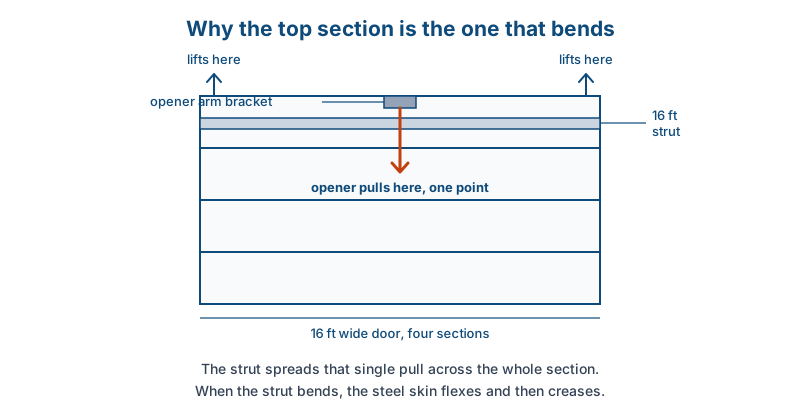
So when the strut loses its shape, nothing else on the door is holding the top section flat. The opener keeps pulling at the same single point, the steel skin starts to flex around it, and the flex turns into a crease. On this door you could see the sequence in progress.

David Yifrach, on what a bent strut is really telling you: "A strut does not bend on its own. Steel that thick only folds when something is making the opener work harder than it should, and nine times out of ten that is spring tension that has drifted off, a roller or a track that is binding, or an arm bracket sitting too high. So when I swap a strut I am not done when the new one is bolted up. If I hand the door back without checking the balance, the customer is calling me again in a season and paying twice for the same lesson."
What we replaced, and what it cost
The old strut came off, the top section was checked for permanent deformation, and a new 16 ft galvanized reinforcement strut went on in its place, fastened through the section the way the original was. This is the heavier part we stock for wide top sections specifically because it adds rigidity and wind-load resistance, which matters on the coast whether or not a storm is in the forecast.

The invoice, in full:
- Labor, residential flat rate, the standard charge for a common residential garage door service call: $235.00
- Strut, 16 ft galvanized reinforcement strut for wide garage door top sections, adds rigidity and wind-load resistance: $179.00
- Total: $414.00, quoted as a written estimate and approved before any work started
No trip fee line, no diagnostic line, no parts we did not use. A narrower single-car door takes a shorter strut, so the same repair comes in under this figure. Note that this is a different job from the hurricane bracing we quote at $120 to $260, which is adding a center strut and re-fastening brackets on a door that is already sound. This one had a damaged part to remove first.
Want the number before we come out? Book a free on-site estimate or call (757) 777-3330. Every quote we hand over is written and line-itemed, and the invoice matches it.
How to tell if your own top section is going
You do not need tools for any of this. Put the door down, stand inside, and look up at the top panel.
- Sight down the strut. Stand at one end of the door and look along the channel like you would sight down a board. A good strut is dead straight for its whole length. Any dip, bow or twist is the problem.
- Look at the bracket. The opener arm bracket is where trouble starts. If the steel around those bolts is dished, folded or pulling away, that is the point taking the load.
- Watch the door open, from inside. A healthy top section rises flat. If the middle of the panel visibly flexes, bows or shudders while the rest of the door moves normally, the strut is not doing its job.
- Run your hand across the outside of the top panel. A crease you can feel is a section problem, not a strut problem, and the fix changes.
- Pull the release and lift by hand. Disconnect the opener and lift the door halfway. It should hold roughly where you leave it. If it drops or climbs, the springs are off, and a new strut on an unbalanced door bends again.
That last check is the one people skip. A bent strut is usually a symptom. For the whole balance test written out step by step, see our garage door maintenance checklist, and if the door is also coming out of its tracks, the off-track guide covers what that combination means. Our garage door parts diagram names every piece mentioned on this page if the vocabulary is new.
When a strut is not the fix
There is a line, and it is worth knowing which side of it you are on before anyone quotes you.
If the section still flexes and springs back, a strut restores it. That was this door. If the section has taken a permanent crease, no brace undoes that, and you are into a section replacement at $350 to $900 installed. If three or more sections are damaged, or the model has been discontinued so a matching section cannot be sourced, a full door is usually the cheaper answer, and we lay that math out in our guide on replacing one panel versus the whole door.
On the coast there is a second reason not to let a bent strut ride. A top section that is already flexing has lost the bracing that helps the door stand up to wind pressure, and Hampton Roads doors get tested every storm season. We wrote about that specifically in brace or replace before hurricane season.
Past the point of a strut? We quote sections and full doors the same way we quoted this repair, in writing, line by line. See our garage door installation and replacement page or book a free measure and quote.
Frequently asked questions
What is a garage door strut and what does it do?
A strut is a long galvanized channel bolted horizontally across the inside face of a garage door section. It keeps a wide section from flexing when the door moves. The top section usually gets one because that is where the opener arm attaches, and it also adds wind-load resistance on wide doors.
How much does it cost to replace a bent garage door strut?
This Norfolk job came to $414 total on September 17, 2026: $235 flat-rate residential labor plus $179 for a 16 ft galvanized reinforcement strut. A narrower single door takes a shorter strut, so it costs less. The figure to compare it against is a section replacement, which runs $350 to $900 installed in Hampton Roads in 2026.
What causes a garage door strut to bend?
Almost always something that made the opener pull harder than the section could take. A weak or broken spring, a door that is out of balance, binding rollers or track, or an opener arm bracket mounted too high are the usual causes. The strut bends first because the opener pulls at one point in the middle of the section.
Can a bent strut be straightened instead of replaced?
Once galvanized steel has creased it does not go back to full strength, so straightening a badly bent strut buys you weeks, not years. Replacing it is the honest fix. What matters more is finding why it bent, because a new strut on an unbalanced door will bend again.
Does a buckling top section mean I need a new garage door?
Not if you catch it while the steel is still flexing rather than creased. On this Norfolk door a new strut was enough. Once a section holds a permanent crease you are into section replacement at $350 to $900 installed, and if three or more sections are damaged a full door usually costs less than fixing them.
More Norfolk work on the board: a pair of salt-air cables that let go in Ocean View, and a Larchmont bottom-seal and doorstop rebuild. For everything we cover in the city, see garage door repair in Norfolk, our emergency garage door repair in Norfolk page for same-day calls, or the full garage door repair service page.
Ready for a written quote?
Free on-site estimate across Norfolk and all of Hampton Roads. A 5.0 rating across 84 Google reviews and 169 Thumbtack reviews. 5-year workmanship warranty. Licensed and insured, Virginia DPOR #2705188091.