Updated 2026-09-22 · by David Yifrach, Owner, Seaside Garage Door Experts · Virginia DPOR #2705188091
Garage Door Strut Replacement: What It Costs, When You Need One, and How Many
A garage door strut replacement runs $95 to $165 per strut when we are already on site for other work, and around $414 as a standalone call on a 16 foot door, which is what one came to on a Norfolk job this month: $235 flat-rate labor plus $179 for the strut. That is the cheap version of this problem. The expensive version is waiting, because a strut that has lost its shape stops holding the section flat, and a section that creases is a $350 to $900 replacement instead. This guide covers what a strut actually does, how many your door needs, how to tell a bent strut from a bent section, what to buy if you are doing it yourself, and where the line sits between a part and a panel.
Key takeaways
- A strut is a horizontal steel channel bolted across a door section. Its only job is to stop that section flexing. It carries no spring tension, which is why it is one of the few garage door parts a careful homeowner can handle.
- The top section is the one that bends, every time. The opener pulls a 16 foot section from a single bracket in the middle, and the strut is the only thing spreading that load.
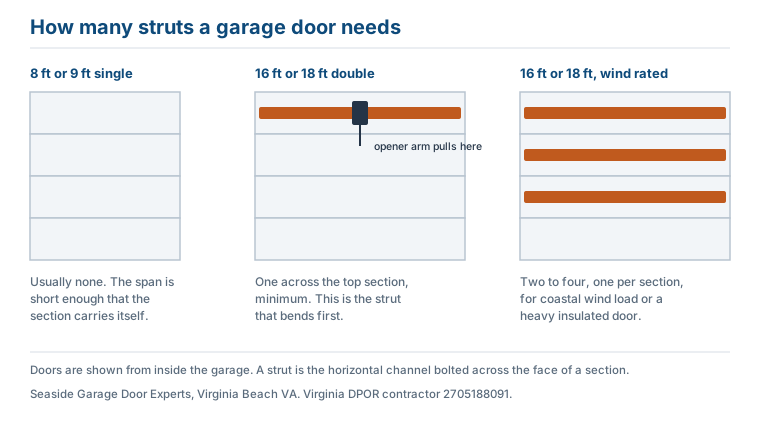
- Count by width. A 16 or 18 foot double needs one strut minimum, on the top section. An 8 or 9 foot single usually needs none. Wind-rated doors carry two to four.
- Flex is fixable, a crease is not. Sight down the section with the door closed: if it springs back flat when you push it, a strut saves it. If it holds a line, you are looking at a section.
- Real 2026 numbers from our own invoices: $414 for a standalone 16 foot strut in Norfolk, $290 for two struts on a Chesapeake door, $120 to $260 to add a center strut and re-fasten the brackets around it.
In this guide
- What a garage door strut actually does
- How many struts does your door need
- Five signs the strut is failing
- What a strut replacement costs in 2026
- Strut or new section: the test that decides
- A real Norfolk job, start to finish
- What to buy: gauge, height and length
- Doing it yourself, and when not to
- Why this comes up so often in Hampton Roads
- Frequently asked questions
What a garage door strut actually does
A strut, also sold as a brace, a truss, a U-bar or a reinforcement bar, is a long galvanized steel channel that bolts horizontally across the inside face of one garage door section. It does one thing: it keeps that section from flexing.
The reason it matters is that a garage door section is a wide, thin piece of steel. On a 16 foot door, that is a sixteen foot span of sheet metal maybe two inches thick. Left alone it would oil-can, which is the term for a thin panel popping in and out of shape under load. The strut turns that floppy span into a beam.
What surprises most people is that the strut is not fighting the weight of the door. The springs handle weight, the cables and drums lift from both ends, and the whole system is balanced so the door weighs almost nothing at the middle of its travel. The strut is fighting something more specific: a single point of pull.
Your opener does not lift the door from the ends. It pulls from one bracket bolted to the center of the top section. So the top section is the only part of the door being yanked at one spot while it tries to move as a sixteen foot unit. The strut is the only thing turning that single point into an even load across the width. Take the strut away, or bend it, and the opener is effectively trying to fold the section around its own bracket.
That is also why, when a strut goes, it almost always goes at the opener bracket. It is not random damage. It is the load path.
How many struts does your door need
This is the question that sends most people to a search bar, and the honest answer depends on three things: how wide the door is, whether an opener is attached, and whether the door was built for wind load.
| Door | Struts needed | Why |
|---|---|---|
| 8 x 7 or 9 x 7 single, no opener | None | Span is short, load is spread by hand at the handle. Most manufacturers ship these bare. |
| 8 or 9 ft single with an opener | One, top section | The single-point pull now exists. Many single doors ship with a factory strut already on the top section for exactly this reason. |
| 16 x 7 or 18 x 7 double | One minimum, top section | This is the baseline. A 16 foot top section with an opener and no strut is a failure waiting for a date. |
| Double, insulated or heavy carriage style | Two, top two sections | More mass swinging through the curve of the track means more flex per cycle. |
| Double, wind-rated or hurricane retrofit | Two to four, one per section | Here the strut is resisting wind pressure across the whole face, not just opener pull. Factory wind-rated doors carry them from new. |
One check that settles it in ten seconds: open your garage, look up at the inside of the door with it closed, and count the horizontal steel bars. If your door is 16 feet wide, an opener is bolted to the top section, and you count zero bars, you have found the thing to fix.
Not sure what you are looking at up there? Send us a photo before you buy anything. It costs nothing and it usually tells us whether this is a $179 part or a $600 panel. Or call (757) 777-3330.
Five signs the strut is failing
A strut rarely snaps. It deforms, slowly, and the door keeps working the whole time, which is why most people catch it late. Here is what to watch for, roughly in the order it shows up.
- The top section bows outward at the middle when the door is closed. Stand inside, close the door, and sight along the section from one end like you are checking a board for straightness. A belly in the middle is the first symptom.
- The section flexes visibly as the door starts to lift. Watch the top section in the first foot of travel. It should move as one plank. If the middle lags and then catches up, the strut is no longer doing its job.
- The strut itself is twisted or folded at the opener bracket. Look at the channel where the opener arm bolts on. A strut that has taken the load too long folds inward right there, and it is obvious once you know to look.
- The opener arm bracket is pulling away from the panel. Bolt heads that have started to dish the steel around them, or a bracket that is no longer flush, mean the load went into the panel instead of the strut.
- A new noise at the top of travel, or the opener straining at the same point each cycle. Flex costs energy. A door whose top section is folding slightly draws more force, and the opener tells you so before the door does.
Anything on that list is worth a look, but the third and fourth are the ones that mean it is already happening and the clock is running. For the wider set of symptoms that point somewhere else entirely, our garage door parts diagram maps what each piece is called and what it does.
What a garage door strut replacement costs in 2026
Strut pricing confuses people because there are really two different jobs wearing the same name, and quotes that look wildly different are usually pricing different ones. Here is how our own numbers break down in Hampton Roads.
| Job | 2026 price | What is in it |
|---|---|---|
| Strut added during another visit | $95 to $165 per strut | Part plus the extra time, on a call we are already making for a tune-up or another repair. Cheapest way to get one. |
| Center strut plus re-fastening brackets | $120 to $260 | The hurricane-prep version. Strut goes on, and every bracket and hinge in that zone gets pulled, checked and re-set. |
| Standalone strut replacement, 16 ft door | About $414 | Our September 17, 2026 Norfolk invoice: $235 flat-rate residential labor plus $179 for a 16 ft galvanized strut. Labor is not shared with another job here, which is the whole difference. |
| Full retrofit bracing kit | $250 to $500 per door | Multiple struts plus reinforced brackets on an existing door, for wind resistance rather than opener load. |
| Single section replacement (too late for a strut) | $350 to $900 installed | New steel section, matched and hung. Whether the section is still manufactured is the first thing we check. |
| New wind-rated 16x7 door installed | $1,985 to $3,800 | On the table when three or more sections are gone, or the door is old enough that sections are unavailable. |
Two real jobs for scale. A Chesapeake homeowner in Grassfield needed two struts on a door that was bowing in the summer heat: $290 total, and the door passed its afternoon test the same week. A Kempsville customer got one strut and an opener force adjustment instead of the new opener she had been quoted elsewhere, and saved roughly $600. Neither of those was a hard diagnosis. They were just cases where somebody looked at the door instead of the symptom.
If you want the full picture on what every common repair runs locally, the numbers all live together in our Hampton Roads garage door repair cost index.
Strut or new section: the test that decides
This is the single question that moves the price by a factor of two, and you can answer it yourself in about a minute. The difference is flex versus set.
Close the door. Go inside. Put a hand flat on the middle of the top section and push, gently. Then let go and look at it from the side, sighting along the section.
- It moves, then springs back flat. The steel is still elastic. It is flexing, not deformed. A new strut takes the load off and the section keeps its shape. This is the $95 to $414 outcome.
- There is a visible line, ridge or crease that stays put. The steel has taken a permanent set. A strut bolted over a creased section holds the crease in place, it does not undo it. This is the $350 to $900 outcome, and adding a strut first is money spent twice.
A second tell: run a finger along the inside face where the crease appears. A flex has no edge to it. A set has a line you can feel.
If it comes back as a section, the next decision is section versus whole door, and there is a real threshold there rather than a sales preference. We wrote that one up separately in panel replacement versus a full door. The short version: one section is usually worth fixing, three or more usually is not.
"The word I listen for on the phone is whether the door is still moving right. If somebody tells me the top of the door looks funny but it opens fine, that is almost always a strut and we are cheap that day. If they tell me it catches or it sounds different, the section has usually already taken a set and I would rather say so on the phone than after they have paid me for a part that will not fix it."
David Yifrach, Owner, Seaside Garage Door Experts
A real Norfolk job, start to finish
On September 17, 2026 we replaced a bent strut on a 16 foot door at a managed rental property in Norfolk 23518. The work order was waiting before the truck rolled, and it was written better than most: the brace at the top of the door was severely damaged and bent, the top section was buckling during operation, and the condition was deteriorating.
That last word is why this stayed a $414 job. Deteriorating means still moving. Still moving means still elastic. The section had not taken its set yet.
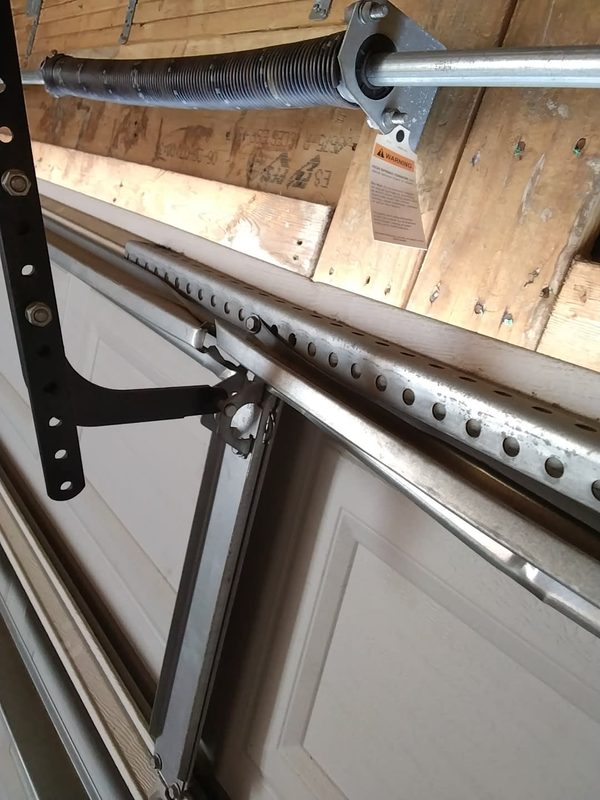
The fix was a new 16 foot galvanized reinforcement strut, $179 for the part and $235 flat-rate residential labor, approved in writing as an estimate before anyone touched the door. Total $414. Had that work order sat another season, the same door would have been a section order at $350 to $900, and section availability on an older door is never guaranteed.
The full write-up, including what the opener bracket looked like underneath and the photos of the new strut in place, is in the Norfolk bent strut case study.
What to buy: gauge, height and length
Search for a garage door strut and you get a wall of product listings and almost no guidance on which one. Here is what the numbers on those listings actually mean.
- Height (the 2 and 1 quarter inch or 3 inch number). This is how tall the channel stands off the door, and it is the main driver of stiffness. Two and a quarter inch is the common residential size. Three inch is stiffer and used on wider or heavier doors. Taller is not always better: the strut has to clear the track, the rollers and the opener arm through the whole curve, so a 3 inch strut on a door with tight headroom can bind.
- Gauge (20, 22 or 24). Lower number is thicker steel. 20 gauge is the heavy-duty end, 24 gauge is light. A 24 gauge strut on a 16 foot wind-exposed door is the most common under-spec we see.
- Length. The strut should span the full section width, corner to corner, not stop short. Residential lengths are sold from about 8 feet up to 24 feet. A short strut anchored in the middle of a section does very little.
- One piece or spliced. Kits that ship in 2 or 4 foot pieces with connectors exist because a 16 foot steel bar is expensive to ship. They work, but every splice is a hinge point, and the splices should never land at the opener bracket.
On price, reading Google Shopping listings for 16 foot struts on September 22, 2026: a specialist supplier listed a repair strut at $39.00 to $96.00 depending on length, a 16 foot steel horizontal support strut listed at $77.00, DDM Garage Doors listed a 2 and 1 quarter inch 22 gauge strut for 16 foot doors at $114.37, and a Menards Ideal Door 2 and 1 quarter inch by 16 foot 24 gauge support strut listed at $149.95. Connector kits for a 16 foot door listed at $119.99 and $159.99. Those are listings read on that date, not quotes, and strut pricing moves with steel.
The thing worth saying plainly: a $39 strut and a $150 strut are not the same part, and the spread is almost entirely gauge, height and length. Match the spec to the door, not the budget.
Doing it yourself, and when not to
We are a repair company and we will still tell you this honestly: a strut is one of the few garage door parts a careful homeowner can fit. It holds no spring tension. Nothing on it is storing energy. That makes it fundamentally different from a spring, a cable or a bottom bracket, all of which can hurt you badly.
What makes it a job anyway is the context:
- You are working overhead, at the top of a closed door, on a ladder.
- The strut bolts through the same zone as the opener bracket and the top fixtures, so you are unbolting things that do matter.
- Self-tapping screws into thin door skin strip easily, and a stripped fastener on a section is a real problem.
- The strut has to clear the track through the whole curve, which you cannot check until the door moves.
Stop immediately and call somebody if any of these are true: a spring is broken or the door feels heavy by hand, a cable is loose, frayed or off its drum, the door is already off track, or the section has a crease rather than a flex. In the first three cases the door is not safe to work on at all, and the fourth means the strut will not fix it.
If the door is balanced, the springs are intact and the top section is only flexing, fitting a strut is an afternoon. If any part of that sentence does not describe your door, that is what our repair service is for, and we will tell you on the phone which one it is.
Why this comes up so often in Hampton Roads
Strut work shows up on our schedule more than it probably does inland, and it is not one cause, it is three stacking on top of each other.
Heat and dark doors. A dark steel door facing west in a Virginia Beach July gets hot enough that the skin expands and the section bows outward on its own. That bow is thermal, it comes back every summer, and the fix on most of those doors is a strut. We ran the pattern on four of them in a single month in 2026 and wrote it up in dark garage doors and thermal bow.
Wind. Coastal Virginia doors take pressure across the full face of the door in a way that a garage in Richmond does not. A wide door with no center strut and no pressure label on it is rated for ordinary wind only, which matters here. That is the reinforcement conversation, not the opener one, and it is covered in our hurricane prep pattern.
Builder-grade doors on newer homes. A lot of the 2016 to 2022 housing stock here went up with light-gauge doors, thin sections and no strut at all on 16 foot openings, because the strut is one of the cheapest things to leave out of a spec. Those doors reach the age where the top section starts flexing right about now.
None of that makes a strut an emergency. It makes it the thing worth looking at on a Saturday, while it is still a part and not a panel.
Family-owned in Virginia Beach since 2013, 5.0 across 84 Google reviews, Virginia DPOR contractor #2705188091. Every quote is a written line item before we start, and our workmanship carries a 5-year warranty. Book a visit or call (757) 777-3330.
Frequently asked questions
How many struts does a garage door need?
A 16 or 18 foot double door needs at least one strut, running the full width of the top section, because that is the section the opener pulls from a single point. Single doors of 8 or 9 feet usually need none, since the span is short enough that the section holds its own shape. Doors built or retrofitted for coastal wind load carry two to four struts, one per section.
How much does it cost to replace a garage door strut?
In Hampton Roads in 2026 we charge $95 to $165 per strut when it is added during a visit we are already making. As a standalone service call the total is higher because the labor is not shared: our September 17, 2026 Norfolk job came to $414, made up of $235 flat-rate residential labor plus $179 for a 16 foot galvanized strut. Adding a center strut and re-fastening the brackets around it runs about $120 to $260.
Can I buy 16 foot garage door struts at Home Depot?
Yes, 16 foot reinforcement struts and strut kits are sold through Home Depot, Lowes and Menards, mostly as third-party kits rather than house brands, and mostly shipped rather than stocked. Reading Google Shopping listings on September 22, 2026, a Menards 2 and 1 quarter inch by 16 foot 24 gauge support strut listed at $149.95, and specialist suppliers listed 16 foot struts from $39.00 up to $114.37. Price is not the thing to compare. Gauge, height and how the piece splices are what decide whether it stiffens the section.
Can I install a garage door strut myself?
A strut can be a homeowner job on a door that is otherwise sound, because the strut itself carries no spring tension. The risk is everything around it: you are working overhead, unbolting the opener bracket zone, and driving fasteners into thin door skin. If the door is balanced, the springs are intact and you can reach the top section safely, it is doable. If a spring is broken, a cable is loose or the door feels heavy by hand, do not work on it at all.
Is a bent garage door strut dangerous?
A bent strut is not usually an immediate hazard the way a broken spring or a frayed cable is, but it is a clock running. Once the strut stops holding the section flat, the opener keeps pulling from one point and the steel flexes a little more every cycle. Flex is repairable with a new strut. A permanent crease is not, and a creased section becomes a $350 to $900 replacement. The cost of waiting is the difference between those two numbers.